One Extra Omamori at Ise Jingu
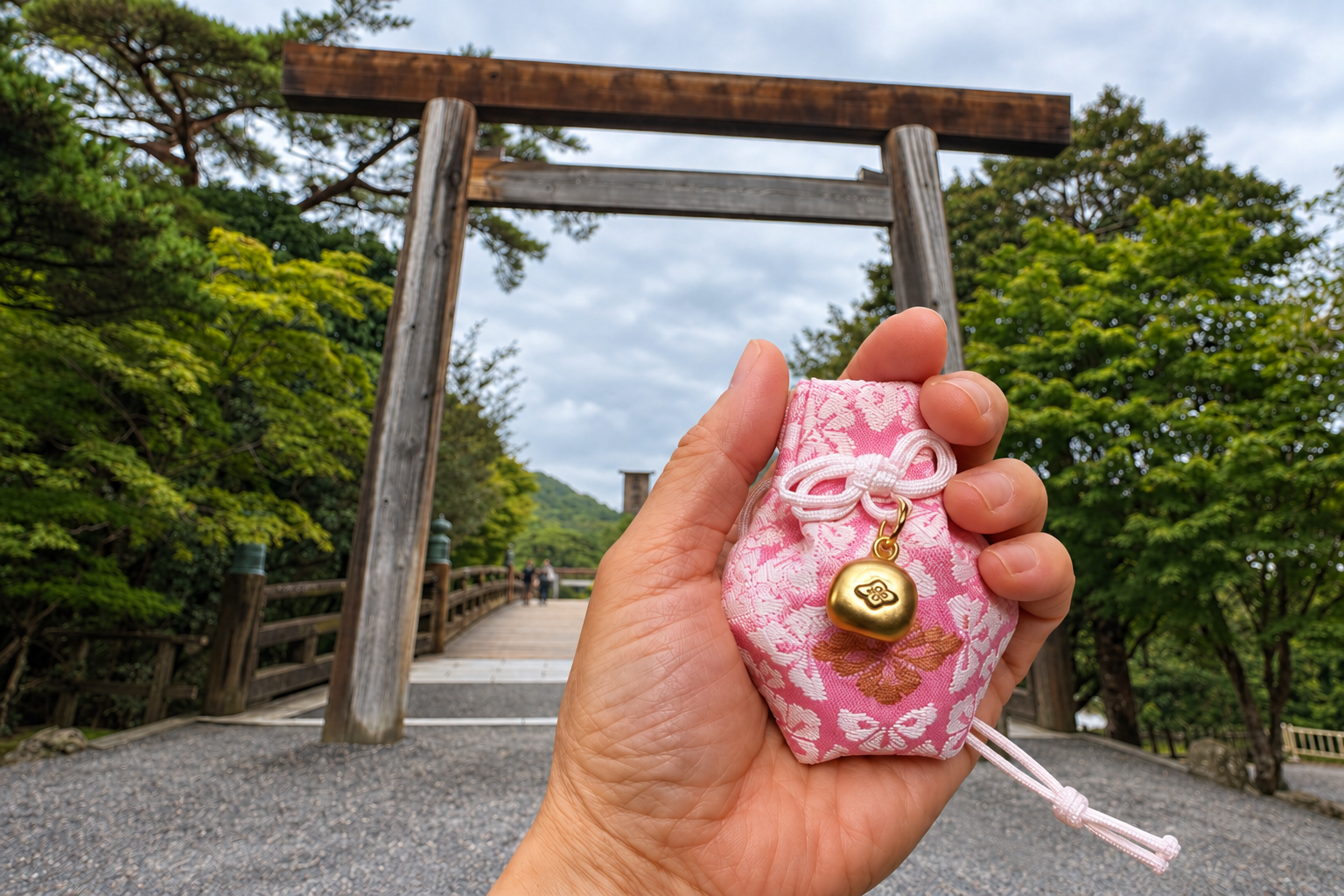
At the counter of Ise Jingu’s Inner Shrine, early in the morning, I lined up the omamori I had chosen and counted them. Then I counted again. It took me…
Five days out, I have a plane ticket and nothing else. Not because I ran out of time — because I don't want to decide yet.
By Yumi Yamaguchi · 10 min read · August 2026
I fly to Japan in five days. I have a plane ticket. That's it.
No hotels. No train tickets. No itinerary. But that's not unusual for me — it's how I've traveled for years, on every continent I've been to. I book the flight, and then, most of the time, I leave the rest alone.
When I mention this, people assume I'm behind. That I meant to book things and ran out of time.
I didn't. I just don't want to decide yet.
And the strange part — the part that made me want to write this — is that the last few weeks have been some of the most enjoyable of the whole thing. Nothing has happened. I haven't gone anywhere. I've just been sitting on the Q train, picturing a court I've never played on, and feeling good about it.
That's not nothing. That might be most of it.
There's a name for what I've been doing on the subway every morning: anticipatory savoring. Psychologist Fred Bryant, who has spent his career studying how people extract enjoyment from positive experiences, describes savoring as something we can do in three directions — backward through memory, forward through anticipation, and in the moment itself. Anticipating a good thing is not a lesser version of having it. It's its own experience, running on its own clock.
The travel research backs this up in a way that's almost uncomfortable. In a study of 1,530 Dutch adults, Jeroen Nawijn and colleagues compared the happiness of people who took a holiday with people who didn't. Vacationers reported greater happiness than non-vacationers — but the difference showed up before the trip, which the authors attributed to anticipation. After returning, there was generally no difference at all. Only a very relaxed trip produced any lasting boost.
Read that again. The measurable happiness advantage of taking a vacation sits mostly in the weeks leading up to it.
So the trip you're taking isn't just the days you're away. It's those days plus however many weeks you spent looking at photos of the coastline, plus the afternoon you spent comparing two neighborhoods you'd never heard of, plus the moment you decided to go at all.
Mine started the day I bought the ticket, and I haven't gone anywhere yet.
Here's the counterintuitive bit: waiting for a thing is mostly unpleasant, but waiting for an experience usually isn't.
Amit Kumar, Matthew Killingsworth, and Thomas Gilovich looked at exactly this across four studies. When people wait for a material purchase — a new phone, a jacket — the waiting tends to be tinged with impatience. When they wait for an experiential one — a trip, a concert — the waiting is more often pleasurable and exciting. They found the pattern in questionnaires about real planned purchases, in a large experience-sampling study, and even in an archival analysis of news coverage of people queuing to buy things.
The economist George Loewenstein had formalized something related decades earlier: anticipation itself produces utility. His model of "savouring" and "dread" explains why someone might deliberately delay a desirable outcome — the interval of looking forward to it is worth something they don't want to give up.
If you've ever put off opening a bottle you were saving, or scheduled the good part of a trip for the back half, you've done this. Waiting isn't the price of the experience. On a good trip, it's part of the experience — sometimes the longest part.
Which raises an obvious question. If waiting is so good, why does trip planning so often feel awful?
Planning this trip, I noticed something I'd never articulated before: not everything unplanned feels the same.
This isn't a framework from a textbook. It's just what I found when I looked at my own list of undecided things and asked which ones felt good and which ones sat on my chest. There turned out to be three.
Where to eat. Whether to take the train up the coast. What to do on the third Tuesday. Nothing bad happens if I don't decide, so the blank stays a blank — and a blank is where imagination goes.
There's research here worth knowing about. Timothy Wilson and colleagues ran three experiments on what they called the pleasures of uncertainty. People experienced something good — in one study, an unexpected dollar coin attached to a card — under conditions that made it either easy or hard to make sense of. Positive moods lasted longer when the event stayed unexplained. The authors called it a pleasure paradox: the mental work of resolving a good event is also what uses it up.
There's a mirror image in the consumer research. Gabriela Tonietto and Selin Malkoc ran 13 studies on ordinary leisure — movies, a coffee break, frozen yogurt with a friend — and found that scheduling an activity, versus doing it impromptu, made it feel less free-flowing and more work-like. It reduced both the excitement beforehand and the enjoyment during.
The detail I find most useful: the effect disappeared when people scheduled roughly, without a prespecified time. So it isn't spontaneity that's magic. It's the clock. "Saturday afternoon, that area" and "2:15 p.m., this address" are different psychological objects.
That's what a fully booked itinerary does to a trip. It converts two weeks of possibility into a list of things you now have to get through. You stop imagining and start executing. And executing is work.
Then there's the other pile.
For me, on this trip, it isn't hotels or trains. It's email. I want to visit several pickleball facilities in Japan, and none of that happens unless I write to them first. Every day I didn't write those emails, they sat there — not as excitement, as a low hum of something unfinished.
This is the kind of undecided that gets sold to us as "keeping options open," and it isn't. It's an unpaid bill. It doesn't generate imagination; it generates a background process that runs whether you want it to or not.
The tell is simple: can you resolve it alone? If yes, and you haven't, it's homework. No amount of reframing turns it into freedom.
And then there's the category I didn't expect to matter as much as it does.
Some of my trip is unplanned because I can't plan it. A friend I haven't seen in years — we'll figure out a day once she knows her schedule. A facility that has to check with its coaches. These aren't decisions I'm avoiding. They're decisions that aren't mine.
At first this felt like the worst kind of limbo. Then I noticed I'd had it backwards. A plan I make alone can only ever contain what I already thought of. A plan I make with someone else arrives with things I couldn't have put there.
The gap in the calendar isn't empty. It's the space another person is going to walk into.
And here's the part I'd have missed if I hadn't watched it happen: these three move.
An unanswered email is category two — my homework, my hum. The moment I hit send, the exact same appointment becomes category three: out of my hands, waiting on someone else, no longer mine to carry. Nothing about the plan changed. Only who's holding it.
That's the actual practical insight, and it's smaller than it sounds. You don't need to eliminate uncertainty. You need to move it out of category two.
I should say clearly: none of this means you should travel the way I do.
Tolerance for the unknown varies enormously between people. It's a dimensional trait, present in everyone to a greater or lesser degree, and it shapes how the same blank square on a calendar registers. What sits comfortably as an open loop for me may land as a genuine irritant for you, and that difference isn't a flaw in either direction.
If you're someone who books everything four months out, you're probably not doing it out of anxiety. You're doing it because researching and deciding is how you savor. The two hours comparing ryokan is your version of my subway daydreaming. The anticipation is identical; the activity carrying it is different.
So the takeaway isn't "book less." It's the thing underneath: clear the homework, protect the imagining, and let the people-shaped gaps stay open. Where your personal line falls between those is nobody's business but yours.
I want to be honest about something, because an article that ends here would be a little too tidy.
There's one thing on my trip that doesn't belong in any of the three categories. A session I wanted to attend — a specific coach, a specific day. I put my name on the waitlist assuming a spot would eventually open. Then I learned the spots don't get released to people like me. It's members-only. There is a seat, and there is no mechanism by which I can sit in it.
That's not a decision I'm deferring, and it isn't homework, and it isn't waiting on anyone's goodwill. Some things are simply closed, and no amount of good planning or right attitude opens them.
I've left my name on the list anyway, because the trip hasn't happened yet and I'd rather find out than assume. But I'd be writing a dishonest article if I told you that leaving space in your plans always gets rewarded. Sometimes you leave space for something and it just doesn't come.
If you've ever come home from a trip and felt oddly flat, part of what you're missing may not be the place at all. It may be the version of yourself that spent six weeks looking forward to it.
That's worth knowing before you plan the next one. The instinct — book everything, lock it down, eliminate the unknowns — quietly spends the best part of the trip before you leave. Every blank you fill in is a blank you can no longer imagine into.
The traveler who books nothing and the traveler who books everything are usually chasing the same thing. One does it by picturing what might happen. The other does it by researching what will. Neither is wrong. But only one of them is at risk of running out of trip before the plane takes off.
Which brings me to the last thing, and the reason I think any of this matters.
Daniel Gilbert and Timothy Wilson's work on affective forecasting established something most travelers eventually learn the hard way: we are bad at predicting how future events will make us feel. We display an impact bias, overestimating both the intensity and the duration of our emotional reactions. The viewpoint you crossed the country for is fine. The unremarkable coffee shop you ducked into because it rained becomes the thing you tell people about for years.
So the trip I've been imagining on the subway is not the trip I'm going to take. I know that.
But here's what I've decided, sitting with a waitlist that probably won't come through: the imagined trip isn't a failed prediction that gets thrown out when the real one shows up. It was time I actually spent. Weeks of it. I was somewhere, mentally, and it was good, and none of that gets retroactively deleted by what does or doesn't happen in September.
I pictured that session more than once. The drive, the courts, what I'd be nervous about. If I never get in, the imagining still happened. It was real experience. It just took place entirely in my head, on the way to work.
Five days out, I have a plane ticket and not much else, and I've stopped apologizing for it.
The homework is mostly sent. Some of it will come back as plans and some of it won't. A few things I wanted are closed to me. Most of the two weeks are still blank, and I'm going to keep them that way — because the blanks are where my friend's schedule goes, and where the coach's answer goes, and where whatever I haven't thought of yet goes.
I'll probably book the first two nights. That's it.
A trip doesn't begin when the wheels leave the runway. It begins the moment you decide to go and start picturing the place.
By that measure, mine has been underway for a while now. And it's going well.
Written the week before departure. By the time I board, a few of these blanks will have filled in — that's the point.
Yumi Yamaguchi
Yumi holds an M.A. in Psychology and writes about the intersection of mental health, human behavior, and travel at Travel-Psych.com. Based in New York, she's a curious explorer of both inner landscapes and outer ones.
Join the Travel-Psych newsletter for articles on how your mind shapes your journeys — and vice versa.
Explore Travel-Psych →This article draws on peer-reviewed research in positive psychology, judgment and decision-making, and consumer behavior. Sources are linked below.
Bryant, F. B., & Veroff, J. (2007). Savoring: A New Model of Positive Experience. Lawrence Erlbaum Associates. Book
The foundational treatment of savoring, distinguishing anticipation, moment-to-moment savoring, and reminiscence as separate routes to enjoyment.
Nawijn, J., Marchand, M. A., Veenhoven, R., & Vingerhoets, A. J. (2010). Vacationers happier, but most not happier after a holiday. Applied Research in Quality of Life, 5(1), 35–47. Springer
https://doi.org/10.1007/s11482-009-9091-9In 1,530 Dutch adults, vacationers reported higher pre-trip happiness than non-vacationers, attributed to anticipation; after returning there was generally no difference, and only a very relaxed trip produced a further boost.
Kumar, A., Killingsworth, M. A., & Gilovich, T. (2014). Waiting for Merlot: Anticipatory consumption of experiential and material purchases. Psychological Science, 25(10), 1924–1931. SAGE
https://doi.org/10.1177/0956797614546556Across four studies, waiting for an experience was more pleasurable and exciting than waiting for a material good.
Loewenstein, G. (1987). Anticipation and the valuation of delayed consumption. The Economic Journal, 97(387), 666–684. Oxford
https://doi.org/10.2307/2232929A model of intertemporal choice incorporating "savouring" and "dread," explaining why people sometimes delay desirable outcomes rather than taking them sooner.
Wilson, T. D., Centerbar, D. B., Kermer, D. A., & Gilbert, D. T. (2005). The pleasures of uncertainty: Prolonging positive moods in ways people do not anticipate. Journal of Personality and Social Psychology, 88(1), 5–21. APA
https://doi.org/10.1037/0022-3514.88.1.5Positive moods lasted longer when a good event remained unexplained — a "pleasure paradox" in which making sense of an event reduces the pleasure it delivers.
Tonietto, G. N., & Malkoc, S. A. (2016). The calendar mindset: Scheduling takes the fun out and puts the work in. Journal of Marketing Research, 53(6), 922–936. SAGE
https://doi.org/10.1509/jmr.14.0591Across 13 studies, scheduling a leisure activity made it feel more work-like and reduced both anticipated and experienced enjoyment; "rough scheduling" without a prespecified time eliminated the effect.
Wilson, T. D., & Gilbert, D. T. (2005). Affective forecasting: Knowing what to want. Current Directions in Psychological Science, 14(3), 131–134. SAGE
https://doi.org/10.1111/j.0963-7214.2005.00355.xAn overview of the impact bias: people overestimate the intensity and duration of their future emotional reactions.
Carleton, R. N. (2016). Into the unknown: A review and synthesis of contemporary models involving uncertainty. Journal of Anxiety Disorders, 39, 30–43. Elsevier
https://doi.org/10.1016/j.janxdis.2016.02.007A review defining fear of the unknown and intolerance of uncertainty as dimensional traits present in everyone to varying degrees.